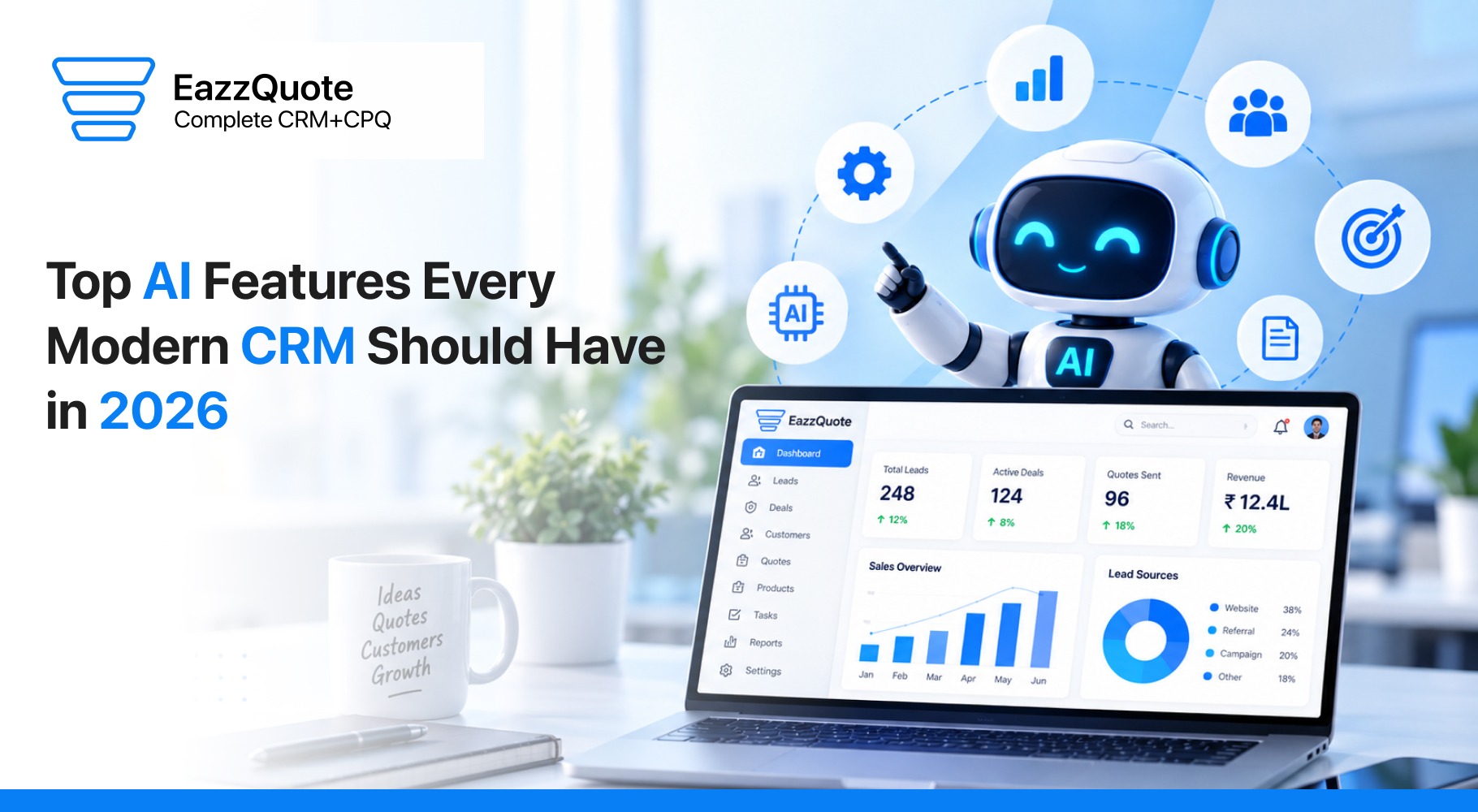
Top AI Features Every Modern CRM Should Have in 2026
Customer expectations are changing rapidly, and businesses need smarter technology to manage growing volumes of customer data and interactions. A modern CRM platform should no longer function only as a digital database. Businesses now expect their CRM to provide insights, automate routine tasks, and support faster decision-making.
This is why CRM with AI is becoming increasingly important.
The integration of artificial intelligence enables CRM platforms to become more intelligent, proactive, and efficient. From identifying the best leads to predicting sales opportunities, AI can help organizations improve every stage of the customer journey.
Here are the top AI CRM features that every modern CRM platform should consider.
1. AI Lead Scoring
One of the most important features of a modern CRM is AI lead scoring.
Not every lead has the same potential to become a customer. Sales teams need to identify which prospects should receive immediate attention.
AI can analyze multiple data points, including customer interactions, website behavior, industry information, communication history, and engagement levels.
Based on this analysis, the CRM can prioritize leads according to their conversion potential.
This allows sales teams to focus on the opportunities that are most likely to generate revenue.
2. Predictive Sales Analytics
A predictive CRM uses historical and real-time data to identify potential future outcomes.
For example, AI can analyze previous sales performance and current opportunities to predict:
- Which deals are likely to close.
- Which customers may stop engaging.
- Which products may generate higher demand.
- Which leads require immediate attention.
Predictive analytics helps businesses move from reactive decision-making to proactive planning.
Instead of waiting for a problem to occur, sales teams can identify potential challenges earlier and take corrective action.
3. Intelligent Follow-Up Automation
Follow-up is one of the most important parts of the sales process. However, busy sales teams can sometimes forget or delay communication with potential customers.
An AI CRM can automatically identify customers who require follow-up and recommend the next action.
The system can send reminders based on:
- Last communication date
- Customer response
- Deal stage
- Lead activity
- Meeting history
This type of CRM automation helps businesses maintain consistent communication and reduce the risk of losing valuable opportunities.
4. AI-Generated Sales Content
Generative AI is becoming an important part of modern business communication.
A generative AI CRM can help sales teams create:
- Follow-up emails
- Sales proposals
- Customer messages
- Meeting summaries
- Product descriptions
- Sales notes
This does not mean that AI should completely replace human communication. Instead, it can provide a starting point and save valuable time.
Sales professionals can review and personalize AI-generated content before sending it to customers.
5. AI Customer Insights
Understanding customers is essential for business success. However, customer information is often spread across emails, calls, support tickets, websites, and sales records.
AI customer insights can analyze this information and provide a clearer understanding of customer behavior.
For example, AI can identify:
- Customers with high purchase potential.
- Customers who may require additional support.
- Common customer concerns.
- Frequently requested products or services.
- Changes in customer engagement.
These insights help businesses create more effective sales and marketing strategies.
6. AI-Powered Sales Intelligence
Sales intelligence allows businesses to understand their sales pipeline more effectively.
An AI-powered CRM can analyze opportunities and provide recommendations to sales representatives.
For example, the CRM may suggest:
- Contact this lead today.
- Schedule a follow-up meeting.
- Send additional product information.
- Review an inactive opportunity.
- Prioritize a high-value customer.
These recommendations help sales teams focus on the right activities.
7. Smart Chatbots and AI Assistants
AI chatbots can provide immediate responses to customers and website visitors. When integrated with a CRM, the chatbot can automatically record interactions and create leads.
An AI assistant can also support internal teams by helping them search for customer information, create reports, or summarize conversations.
For example, a sales manager could ask the AI assistant:
“Which sales opportunities have been inactive for more than 30 days?”
The AI assistant could quickly analyze CRM data and provide relevant information.
This makes CRM software easier and faster to use.
8. Automated Data Entry
Manual data entry is one of the biggest challenges for sales teams. Employees may forget to update customer records or enter incomplete information.
AI can help automate data capture from emails, forms, meetings, and customer interactions.
This improves productivity and ensures that important customer information is available within the CRM.
Automated data entry can also reduce human errors and duplicate records.
9. Conversation Intelligence
Sales calls and customer conversations contain valuable information. However, manually reviewing every conversation is difficult.
AI-powered conversation intelligence can analyze communication and identify important topics, customer concerns, and potential opportunities.
The CRM can automatically generate summaries and identify key action points.
This helps managers understand customer interactions without manually reviewing every communication.
10. Smart Workflow Automation
Traditional workflows follow predefined rules. AI can make workflow automation more intelligent.
For example, the CRM can determine which actions should be prioritized based on customer behavior and historical data.
A smart CRM may automatically assign leads to the most appropriate sales representative based on location, industry, expertise, or availability.
This improves operational efficiency and creates a more effective customer experience.
11. Advanced Sales Forecasting
Accurate forecasting is essential for business growth. AI can analyze large volumes of data to create more realistic sales predictions.
The system can consider current pipeline performance, historical sales results, seasonal trends, and customer behavior.
Managers can use these insights to set realistic targets and plan future business strategies.
12. Next-Best-Action Recommendations
One of the most advanced AI CRM features is the ability to recommend the next best action.
Instead of requiring employees to analyze every customer manually, the CRM can suggest what should happen next.
For example:
- Call the customer.
- Send a proposal.
- Schedule a product demonstration.
- Share relevant information.
- Escalate a customer concern.
This makes the CRM more proactive and helps employees work more efficiently.
How AI Will Define the Future of CRM
The future of smart sales software will focus on intelligence, automation, and personalization.
Businesses will increasingly use AI to reduce repetitive work and help employees make faster decisions. However, successful CRM strategies will continue to require a human element.
AI should support employees rather than completely replace customer relationships.
The most successful businesses will combine AI technology with human expertise, creativity, and relationship-building skills.
Conclusion
The adoption of CRM with AI is no longer simply a technology trend. It is becoming an important part of modern sales and customer relationship strategies.
Features such as AI lead scoring, predictive analytics, intelligent automation, AI customer insights, and sales intelligence can help businesses improve productivity and customer engagement.
A modern CRM should not simply store customer information. It should help businesses understand their customers, identify opportunities, and recommend the right actions.
As AI technology continues to evolve, AI CRM features will become increasingly important for businesses that want to create smarter, faster, and more personalized customer experiences.
Convert More Leads with Smarter Quotation Management — Try EazzQuote.
Get Started FreeTags
FAQs – AI CRM
AI CRM features include AI lead scoring, automation, analytics, and customer insights.
A CRM with AI uses artificial intelligence to automate tasks and improve sales decisions.
AI lead scoring automatically ranks leads based on their conversion potential.
A predictive CRM uses data and AI to forecast customer behavior and sales outcomes.
AI automates repetitive tasks such as follow-ups, reminders, and customer communications.
AI analyzes customer data to identify patterns, preferences, and opportunities.
A generative AI CRM can create emails, summaries, responses, and sales content automatically.
Yes. An AI chatbot can answer customer questions, qualify leads, and support sales teams 24/7.
Contact
Email: info@eazzquote.com
Contact Us: +91-9124985345 | +971-561292026